Witch and Hare
An old witch, in days of yore, lived in this neighbourhood; and whenever she wanted money she would assume the shape of a hare, and would send out her grandson to tell a certain huntsman who lived hard by that he had seen a hare sitting at such a particular spot, for which he always received the reward of sixpence. After this deception had many times been practised, the dogs turned out, the hare pursued, often seen but never caught, a sportsman of the party began to suspect, in the language of the tradition, "that the devil was in the dance," and there would be no end to it.
The matter was discussed, a justice consulted, and a clergyman to boot; and it was thought that, however clever the devil might be, law and church combined would be more than a match for him. It was therefore agreed that, as the boy was singularly regular in the hour at which he came to announce the sight of the hare, all should be in readiness for a start the instant such information was given: and a neighbour of the witch, nothing friendly to her, promised to let the parties know directly the old woman and her grandson left the cottage and went off together; the one to be hunted, and the other to set on the hunt.
The news came, the hounds were unkennelled, and huntsmen and sportsmen set off with surprising speed. The witch, now a hare, and her little colleague in iniquity, did not expect so very speedy a turn out; so that the game was pursued at a desperate rate, and the boy, forgetting himself in a moment of alarm, was heard to exclaim: "Run, Granny, run; run for your life!" At last the pursuers lost the hare, and she once more got safe into the cottage by a little hole in the door; not large enough to admit a hound in chase.
The huntsman and all the squires with their train lent a hand to break open the door, yet could not do it till the parson and the justice came up; but as law and church were certainly designed to break through iniquity, even so did they now succeed in bursting the magic bonds that opposed them. Upstairs they all went. There they found the old hag bleeding, and covered with wounds, and still out of breath. She denied she was a hare, and railed at the whole party. "Call up the hounds," said the huntsman, "and let us see what they take her to be; maybe we may yet have another hunt."
On hearing this the old woman cried quarter. The boy dropped on his knees, and begged hard for mercy, which was granted on condition of its being received together with a good whipping; and the huntsman, having long practised amongst the hounds, now tried his hand on other game. Thus the old woman escaped a worse fate for the time present; but on being afterwards put on her trial for bewitching a young woman and making her spit pins, the tale just told was given as evidence against her, before a particularly learned judge, and a remarkably sagacious jury, and the old woman finished her days, like a martyr, at the stake.
Footnotes
Mrs. Bray, The Borders of the Tamar and the Tavy
Sacred Texts
Showing posts with label folk tale. Show all posts
Wednesday, August 29, 2018
Thursday, August 9, 2018
The Old Witch
The Old Witch
Once upon a time there were two girls who lived with their mother and father. Their father had no work, and the girls wanted to go away and seek their fortunes. Now one girl wanted to go to service, and her mother said she might if she could find a place. So she started for the town. Well, she went all about the town, but no one wanted a girl like her. So she went on farther into the country, and she came to the place where there was an oven where there was lots of bread baking.
And the bread said, 'Little girl, little girl, take us out, take us out. We have been baking seven years, and no one has come to take us out.' So the girl took out the bread, laid it on the ground and went on her way.
Then she met a cow, and the cow said, 'Little girl, little girl, milk me, milk me! Seven years have I been waiting, and no one has come to milk me.' The girl milked the cow into the pails that stood by. As she was thirsty she drank some, and left the rest in the pails by the cow.
Then she went on a little farther, and came to an apple-tree, so loaded with fruit that its branches were breaking down, and the tree said, 'Little girl, little girl, help me shake my fruit. My branches are breaking, it is so heavy.' And the girl said, 'Of course I will, you poor tree.' So she shook the fruit all off, propped up the branches, and left the fruit on the ground under the tree.
Then she went on again till she came to a house. Now in this house there lived a witch, and this witch took girls into her house as servants. And when she heard that this girl had left her home to seek service, she said that she would try her, and give her good wages. The witch told the girl what work she was to do. 'You must keep the house clean and tidy, sweep the floor and the fireplace; but there is one thing you must never do. You must never look up the chimney, or something bad will befall you.'
So the girl promised to do as she was told, but one morning as she was cleaning, and the witch was out, she forgot what the witch said, and looked up the chimney. When she did this a great bag of money fell down in her lap. This happened again and again. So the girl started to go off home.
When she had gone some way she heard the witch coming after her. So she ran to the apple-tree and cried:
'Apple-tree, apple-tree, hide me,
So the old witch can't find me;
If she does she'll pick my bones,
And bury me under the marble stones.'
So the apple-tree hid her. When the witch came up she said:
'Tree of mine, tree of mine,
Have you seen a girl
With a willy-willy wag, and a long-tailed bag,
Who's stole my money, all I had?'
And the apple-tree said, 'No, mother; not for seven year.'
When the witch had gone down another way, the girl went on again, and just as she got to the cow heard the witch coming after her again, so she ran to the cow and cried:
'Cow, cow, hide me,
So the old witch can't find me;
If she does she'll pick my bones,
And bury me under the marble stones.'
So the cow hid her.
When the old witch came up, she looked about and said to the cow:
'Cow of mine, cow of mine,
Have you seen a girl
With a willy-willy wag, and a long-tailed bag,
Who's stole my money, all I had?'
And the cow said, 'No, mother, not for seven year.'
When the witch had gone off another way, the little girl went on again, and when she was near the oven she heard the witch coming after her again, so she ran to the oven and cried:
'Oven, oven, hide me,
So the old witch can't find me;
If she does she'll pick my bones,
And bury me under the marble stones.'
And the oven said, 'I've no room, ask the baker,' and the baker hid her behind the oven.
When the witch came up she looked here and there and everywhere, and then said to the baker:
'Man of mine, man of mine,
Have you seen a girl,
With a willy-willy wag, and a long-tailed bag,
Who's stole my money, all I had?'
So the baker said, 'Look in the oven.' The old witch went to look, and the oven said, 'Get in and look in the furthest corner.' The witch did so, and when she was inside the oven shut her door, and the witch was kept there for a very long time.
The girl then went off again, and reached her home with her money bags, married a rich man, and lived happy ever afterwards.
The other sister then thought she would go and do the same. And she went the same way. But when she reached the oven, and the bread said, 'Little girl, little girl, take us out. Seven years have we been baking, and no one has come to take us out', the girl said, 'No, I don't want to burn my fingers.'
So she went on till she met the cow, and the cow said, 'Little girl, little girl, milk me, milk me, do. Seven years have I been waiting, and no one has come to milk me.' But the girl said, 'No, I can't milk you, I'm in a hurry,' and went on faster.
Then she came to the apple-tree, and the apple-tree asked her to help shake the fruit. 'No, I can't; another day p'raps I may,' and went on till she came to the witch's house.
Well, it happened to her just the same as to the other girl -- she forgot what she was told, and, one day when the witch was out, looked up the chimney, and down fell a bag of money. Well, she thought she would be off at once. When she reached the apple-tree, she heard the witch coming after her, and she cried:
'Apple-tree, apple-tree, hide me,
So the old witch can't find me;
If she does she'll pick my bones,
And bury me under the marble stones.'
But the tree didn't answer, and she ran on further. Presently the witch came up and said:
'Tree of mine, tree of mine,
Have you seen a girl,
With a willy-willy wag, and a long-tailed bag,
Who's stole my money, all I had?'
The tree said, 'Yes, mother; she's gone down that way.'
So the old witch went after her and caught her; she took all the money away from her, beat her, and sent her off home just as she was.
Sacred Texts
Once upon a time there were two girls who lived with their mother and father. Their father had no work, and the girls wanted to go away and seek their fortunes. Now one girl wanted to go to service, and her mother said she might if she could find a place. So she started for the town. Well, she went all about the town, but no one wanted a girl like her. So she went on farther into the country, and she came to the place where there was an oven where there was lots of bread baking.
And the bread said, 'Little girl, little girl, take us out, take us out. We have been baking seven years, and no one has come to take us out.' So the girl took out the bread, laid it on the ground and went on her way.
Then she met a cow, and the cow said, 'Little girl, little girl, milk me, milk me! Seven years have I been waiting, and no one has come to milk me.' The girl milked the cow into the pails that stood by. As she was thirsty she drank some, and left the rest in the pails by the cow.
Then she went on a little farther, and came to an apple-tree, so loaded with fruit that its branches were breaking down, and the tree said, 'Little girl, little girl, help me shake my fruit. My branches are breaking, it is so heavy.' And the girl said, 'Of course I will, you poor tree.' So she shook the fruit all off, propped up the branches, and left the fruit on the ground under the tree.
Then she went on again till she came to a house. Now in this house there lived a witch, and this witch took girls into her house as servants. And when she heard that this girl had left her home to seek service, she said that she would try her, and give her good wages. The witch told the girl what work she was to do. 'You must keep the house clean and tidy, sweep the floor and the fireplace; but there is one thing you must never do. You must never look up the chimney, or something bad will befall you.'
So the girl promised to do as she was told, but one morning as she was cleaning, and the witch was out, she forgot what the witch said, and looked up the chimney. When she did this a great bag of money fell down in her lap. This happened again and again. So the girl started to go off home.
When she had gone some way she heard the witch coming after her. So she ran to the apple-tree and cried:
'Apple-tree, apple-tree, hide me,
So the old witch can't find me;
If she does she'll pick my bones,
And bury me under the marble stones.'
So the apple-tree hid her. When the witch came up she said:
'Tree of mine, tree of mine,
Have you seen a girl
With a willy-willy wag, and a long-tailed bag,
Who's stole my money, all I had?'
And the apple-tree said, 'No, mother; not for seven year.'
When the witch had gone down another way, the girl went on again, and just as she got to the cow heard the witch coming after her again, so she ran to the cow and cried:
'Cow, cow, hide me,
So the old witch can't find me;
If she does she'll pick my bones,
And bury me under the marble stones.'
So the cow hid her.
When the old witch came up, she looked about and said to the cow:
'Cow of mine, cow of mine,
Have you seen a girl
With a willy-willy wag, and a long-tailed bag,
Who's stole my money, all I had?'
And the cow said, 'No, mother, not for seven year.'
When the witch had gone off another way, the little girl went on again, and when she was near the oven she heard the witch coming after her again, so she ran to the oven and cried:
'Oven, oven, hide me,
So the old witch can't find me;
If she does she'll pick my bones,
And bury me under the marble stones.'
And the oven said, 'I've no room, ask the baker,' and the baker hid her behind the oven.
When the witch came up she looked here and there and everywhere, and then said to the baker:
'Man of mine, man of mine,
Have you seen a girl,
With a willy-willy wag, and a long-tailed bag,
Who's stole my money, all I had?'
So the baker said, 'Look in the oven.' The old witch went to look, and the oven said, 'Get in and look in the furthest corner.' The witch did so, and when she was inside the oven shut her door, and the witch was kept there for a very long time.
The girl then went off again, and reached her home with her money bags, married a rich man, and lived happy ever afterwards.
The other sister then thought she would go and do the same. And she went the same way. But when she reached the oven, and the bread said, 'Little girl, little girl, take us out. Seven years have we been baking, and no one has come to take us out', the girl said, 'No, I don't want to burn my fingers.'
So she went on till she met the cow, and the cow said, 'Little girl, little girl, milk me, milk me, do. Seven years have I been waiting, and no one has come to milk me.' But the girl said, 'No, I can't milk you, I'm in a hurry,' and went on faster.
Then she came to the apple-tree, and the apple-tree asked her to help shake the fruit. 'No, I can't; another day p'raps I may,' and went on till she came to the witch's house.
Well, it happened to her just the same as to the other girl -- she forgot what she was told, and, one day when the witch was out, looked up the chimney, and down fell a bag of money. Well, she thought she would be off at once. When she reached the apple-tree, she heard the witch coming after her, and she cried:
'Apple-tree, apple-tree, hide me,
So the old witch can't find me;
If she does she'll pick my bones,
And bury me under the marble stones.'
But the tree didn't answer, and she ran on further. Presently the witch came up and said:
'Tree of mine, tree of mine,
Have you seen a girl,
With a willy-willy wag, and a long-tailed bag,
Who's stole my money, all I had?'
The tree said, 'Yes, mother; she's gone down that way.'
So the old witch went after her and caught her; she took all the money away from her, beat her, and sent her off home just as she was.
Sacred Texts
Tuesday, August 7, 2018
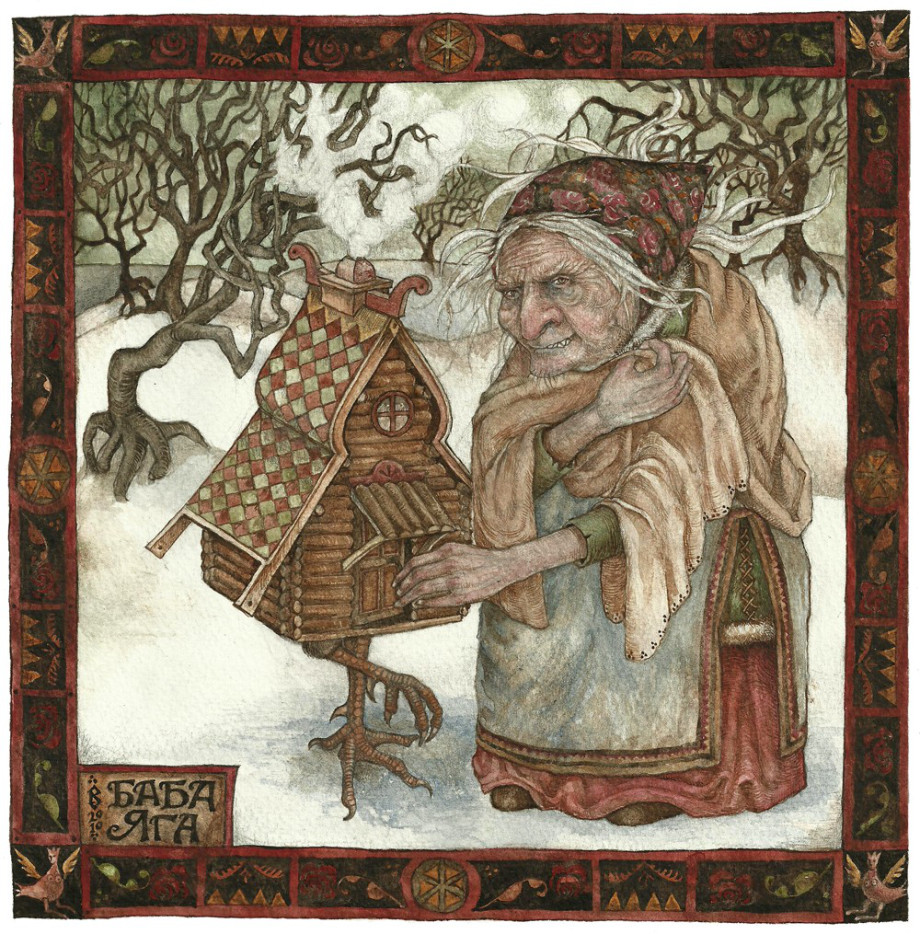
Baba Yaga
Baba Yaga
a Russian folk tale
SOMEWHERE, I cannot tell you exactly where, but certainly in vast Russia, there lived a peasant with his wife and they had twins — a son and daughter. One day the wife died and the husband mourned over her very sincerely for a long time. One year passed, and two years, and even longer. But there is no order in a house without a woman, and a day came when the man thought, "If I marry again possibly it would turn out all right." And so he did, and had children by his second wife.
The stepmother was envious of the stepson and daughter and began to use them hardly. She scolded them without any reason, sent them away from home as often as she wished, and gave them scarcely enough to eat. Finally she wanted to get rid of them altogether. Do you know what it means to allow a wicked thought to enter one's heart?
The wicked thought grows all the time like a poisonous plant and slowly kills the good thoughts. A wicked feeling was growing in the stepmother's heart, and she determined to send the children to the witch, thinking sure enough that they would never return.
"Dear children,"she said to the orphans, "go to my grandmother who lives in the forest in a hut on hen's feet. You will do everything she wants you to, and she will give you sweet things to eat and you will be happy."
The orphans started out. But instead of going to the witch, the sister, a bright little girl, took her brother by the hand and ran to their own old, old grandmother and told her all about their going to the forest.
"Oh, my poor darlings!" said the good old grandmother, pitying the children, "my heart aches for you, but it is not in my power to help you. You have to go not to a loving grandmother, but to a wicked witch. Now listen to me, my darlings," she continued; "I will give you a hint: Be kind and good to everyone; do not speak ill words to any one; do not despise helping the weakest, and always hope that for you, too, there will be the needed help."
The good old grandmother gave the children some delicious fresh milk to drink and to each a big slice of ham. She also gave them some cookies—there are cookies everywhere—and when the children departed she stood looking after them a long, long time.
The obedient children arrived at the forest and, oh, wonder! there stood a hut, and what a curious one! It stood on tiny hen's feet, and at the top was a rooster's head. With their shrill, childish voices they called out loud: "Izboushka, Izboushka! turn thy back to the forest and thy front to us!" The hut did as they commanded. The two orphans looked inside and saw the witch resting there, her head near the threshold, one foot in one corner, the other foot in another corner, and her knees quite close to the ridge pole.
"Fou, Fou, Fou!" exclaimed the witch; "I feel the Russian spirit."
The children were afraid, and stood close, very close together, but in spite of their fear they said very politely:
"Ho, grandmother, our stepmother sent us to thee to serve thee."
"All right; I am not opposed to keeping you, children. If you satisfy all my wishes I shall reward you; if not, I shall eat you up."
Without any delay the witch ordered the girl to spin the thread, and the boy, her brother, to carry water in a sieve to fill a big tub. The poor orphan girl wept at her spinning-wheel and wiped away her bitter tears. At once all around her appeared small mice squeaking and saying:
"Sweet girl, do not cry. Give us cookies and we will help thee." The little girl willingly did so.
"Now,"gratefully squeaked the mice, "go and find the black cat. He is very hungry; give him a slice of ham and he will help thee."
The girl speedily went in search of the cat and saw her brother in great distress about the tub, so many times he had filled the sieve, yet the tub was still dry. The little birds passed, flying near by, and chirped to the children: "Kind-hearted little children, give us some crumbs and we will advise you." The orphans gave the birds some crumbs and the grateful birds chirped again:
"Some clay and water, children dear!" Then away they flew through the air.
The children understood the hint, spat in the sieve, plastered it up with clay and rilled the tub in a very short time. Then they both returned to the hut and on the threshold met the black cat. They generously gave him some of the good ham which their good grandmother had given them, petted him and asked:
"Dear Kitty-cat, black and pretty, tell us what to do in order to get away from thy mistress, the witch?"
"Well," very seriously answered the cat, "I will give you a towel and a comb and then you must run away. When you hear the witch running after you, drop the towel behind your back and a large river will appear in place of the towel.
If you hear her once more, throw down the comb and in place of the comb there will appear a dark wood. This wood will protect you from the wicked witch, my mistress."
Baba Yaga came home just then.
"Is it not wonderful?" she thought; "everything is exactly right."
"Well," she said to the children, "today you were brave and smart; let us see to-morrow. Your work will be more difficult and I hope I shall eat you up."
The poor orphans went to bed, not to a warm bed prepared by loving hands, but on the straw in a cold corner. Nearly scared to death from fear, they lay there, afraid to talk, afraid even to breathe. The next morning the witch ordered all the linen to be woven and a large supply of firewood to be brought from the forest.
The children took the towel and comb and ran away as fast as their feet could possibly carry them. The dogs were after them, but they threw them the cookies that were left; the gates did not open themselves, but the children smoothed them with oil; the birch tree near the path almost scratched their eyes out, but the gentle girl fastened a pretty ribbon to it. So they went farther and farther and ran out of the dark forest into the wide, sunny fields.
The cat sat down by the loom and tore the thread to pieces, doing it with delight. Baba Yaga returned. "Where are the children?" she shouted, and began to beat the cat. "Why hast thou let them go, thou treacherous cat? Why hast thou not scratched their faces?"
The cat answered: "Well, it was because I have served thee so many years and thou hast never given me a bite, while the dear children gave me some good ham."
The witch scolded the dogs, the gates, and the birch tree near the path. "Well," barked the dogs, "thou certainly art our mistress, but thou hast never done us a favor, and the orphans were kind to us."
The gates replied: "We were always ready to obey thee, but thou didst neglect us, and the dear children smoothed us with oil."
"The children ran away as fast as their feet could possibly carry them"
The birch tree lisped with its leaves, "Thou hast never put a simple thread over my branches and the little darlings adorned them with a pretty ribbon."
Baba Yaga understood that there was no help and started to follow the children herself. In her great hurry she forgot to look for the towel and the comb, but jumped astride a broom and was off. The children heard her coming and threw the towel behind them. At once a river, wide and blue, appeared and watered the field. Baba Yaga hopped along the shore until she finally found a shallow place and crossed it.
Again the children heard her hurry after them and so they threw down the comb. This time a forest appeared, a dark and dusky forest in which the roots were interwoven, the branches matted together, and the tree-tops touching each other. The witch tried very hard to pass through, but in vain, and so, very, very angry, she returned home.
The orphans rushed to their father, told him all about their great distress, and thus concluded their pitiful story:
"Ah, father dear, why dost thou love us less than our brothers and sisters?"
The father was touched and became angry. He sent the wicked stepmother away and lived a new life with his good children. From that time he watched over their happiness and never neglected them any more.
How do I know this story is true? Why, one was there who told me about it.
Folk Tales From the Russian, by Verra Xenophontovna Kalamatiano de Blumenthal, [1903]
Sacred Texts
Like most witches, Baba Yaga can fly but she does not use a broomstick. Instead, she sits in a giant mortar (a bowl for grinding food) with her knees almost touching her chin. She drives very fast across or above the forest floor, and uses the pestle (the grinder) as a rudder held in her right hand. She sweeps away her tracks with a broom made out of silver birch held in her left hand. Wherever she appears, a wild wind begins to blow, the trees groan and leaves whirl through the air.
Her home is a hut deep in a birch forest, in a place that is difficult to find, unless a magic thread, feather or doll shows the way. The hut has a life of its own. It stands on large chicken legs and can move about. Its windows act as eyes and the lock is full of teeth. A post fence surrounds the hut. The posts are made of human bones and topped with skulls whose blazing eye sockets light up the forest. Very often the hut is guarded by hungry dogs, evil geese, swans or a black cat.
The hut can spin around and moves through the forest. It makes blood-curdling screeches. Most of those who go in never leave, as Baba Yaga washes them, feeds them and then sits them on a giant spatula, before putting them in her oven. In many stories, the fate of those entering her hut is in their own hands. A guest may, or may not, fit into the oven, depending on how they sit on the spatula. Although she eats as much as 10 men, Baba Yaga is very skinny and bony, like a skeleton. Her nose is very long and hooked.
http://myths.e2bn.org/mythsandlegends/origins117-baba-yaga-and-vasilisa-the-fair.html
a Russian folk tale
SOMEWHERE, I cannot tell you exactly where, but certainly in vast Russia, there lived a peasant with his wife and they had twins — a son and daughter. One day the wife died and the husband mourned over her very sincerely for a long time. One year passed, and two years, and even longer. But there is no order in a house without a woman, and a day came when the man thought, "If I marry again possibly it would turn out all right." And so he did, and had children by his second wife.
The stepmother was envious of the stepson and daughter and began to use them hardly. She scolded them without any reason, sent them away from home as often as she wished, and gave them scarcely enough to eat. Finally she wanted to get rid of them altogether. Do you know what it means to allow a wicked thought to enter one's heart?
The wicked thought grows all the time like a poisonous plant and slowly kills the good thoughts. A wicked feeling was growing in the stepmother's heart, and she determined to send the children to the witch, thinking sure enough that they would never return.
"Dear children,"she said to the orphans, "go to my grandmother who lives in the forest in a hut on hen's feet. You will do everything she wants you to, and she will give you sweet things to eat and you will be happy."
The orphans started out. But instead of going to the witch, the sister, a bright little girl, took her brother by the hand and ran to their own old, old grandmother and told her all about their going to the forest.
"Oh, my poor darlings!" said the good old grandmother, pitying the children, "my heart aches for you, but it is not in my power to help you. You have to go not to a loving grandmother, but to a wicked witch. Now listen to me, my darlings," she continued; "I will give you a hint: Be kind and good to everyone; do not speak ill words to any one; do not despise helping the weakest, and always hope that for you, too, there will be the needed help."
The good old grandmother gave the children some delicious fresh milk to drink and to each a big slice of ham. She also gave them some cookies—there are cookies everywhere—and when the children departed she stood looking after them a long, long time.
The obedient children arrived at the forest and, oh, wonder! there stood a hut, and what a curious one! It stood on tiny hen's feet, and at the top was a rooster's head. With their shrill, childish voices they called out loud: "Izboushka, Izboushka! turn thy back to the forest and thy front to us!" The hut did as they commanded. The two orphans looked inside and saw the witch resting there, her head near the threshold, one foot in one corner, the other foot in another corner, and her knees quite close to the ridge pole.
"Fou, Fou, Fou!" exclaimed the witch; "I feel the Russian spirit."
The children were afraid, and stood close, very close together, but in spite of their fear they said very politely:
"Ho, grandmother, our stepmother sent us to thee to serve thee."
"All right; I am not opposed to keeping you, children. If you satisfy all my wishes I shall reward you; if not, I shall eat you up."
Without any delay the witch ordered the girl to spin the thread, and the boy, her brother, to carry water in a sieve to fill a big tub. The poor orphan girl wept at her spinning-wheel and wiped away her bitter tears. At once all around her appeared small mice squeaking and saying:
"Sweet girl, do not cry. Give us cookies and we will help thee." The little girl willingly did so.
"Now,"gratefully squeaked the mice, "go and find the black cat. He is very hungry; give him a slice of ham and he will help thee."
The girl speedily went in search of the cat and saw her brother in great distress about the tub, so many times he had filled the sieve, yet the tub was still dry. The little birds passed, flying near by, and chirped to the children: "Kind-hearted little children, give us some crumbs and we will advise you." The orphans gave the birds some crumbs and the grateful birds chirped again:
"Some clay and water, children dear!" Then away they flew through the air.
The children understood the hint, spat in the sieve, plastered it up with clay and rilled the tub in a very short time. Then they both returned to the hut and on the threshold met the black cat. They generously gave him some of the good ham which their good grandmother had given them, petted him and asked:
"Dear Kitty-cat, black and pretty, tell us what to do in order to get away from thy mistress, the witch?"
"Well," very seriously answered the cat, "I will give you a towel and a comb and then you must run away. When you hear the witch running after you, drop the towel behind your back and a large river will appear in place of the towel.
If you hear her once more, throw down the comb and in place of the comb there will appear a dark wood. This wood will protect you from the wicked witch, my mistress."
Baba Yaga came home just then.
"Is it not wonderful?" she thought; "everything is exactly right."
"Well," she said to the children, "today you were brave and smart; let us see to-morrow. Your work will be more difficult and I hope I shall eat you up."
The poor orphans went to bed, not to a warm bed prepared by loving hands, but on the straw in a cold corner. Nearly scared to death from fear, they lay there, afraid to talk, afraid even to breathe. The next morning the witch ordered all the linen to be woven and a large supply of firewood to be brought from the forest.
The children took the towel and comb and ran away as fast as their feet could possibly carry them. The dogs were after them, but they threw them the cookies that were left; the gates did not open themselves, but the children smoothed them with oil; the birch tree near the path almost scratched their eyes out, but the gentle girl fastened a pretty ribbon to it. So they went farther and farther and ran out of the dark forest into the wide, sunny fields.
The cat sat down by the loom and tore the thread to pieces, doing it with delight. Baba Yaga returned. "Where are the children?" she shouted, and began to beat the cat. "Why hast thou let them go, thou treacherous cat? Why hast thou not scratched their faces?"
The cat answered: "Well, it was because I have served thee so many years and thou hast never given me a bite, while the dear children gave me some good ham."
The witch scolded the dogs, the gates, and the birch tree near the path. "Well," barked the dogs, "thou certainly art our mistress, but thou hast never done us a favor, and the orphans were kind to us."
The gates replied: "We were always ready to obey thee, but thou didst neglect us, and the dear children smoothed us with oil."
"The children ran away as fast as their feet could possibly carry them"
The birch tree lisped with its leaves, "Thou hast never put a simple thread over my branches and the little darlings adorned them with a pretty ribbon."
Baba Yaga understood that there was no help and started to follow the children herself. In her great hurry she forgot to look for the towel and the comb, but jumped astride a broom and was off. The children heard her coming and threw the towel behind them. At once a river, wide and blue, appeared and watered the field. Baba Yaga hopped along the shore until she finally found a shallow place and crossed it.
Again the children heard her hurry after them and so they threw down the comb. This time a forest appeared, a dark and dusky forest in which the roots were interwoven, the branches matted together, and the tree-tops touching each other. The witch tried very hard to pass through, but in vain, and so, very, very angry, she returned home.
The orphans rushed to their father, told him all about their great distress, and thus concluded their pitiful story:
"Ah, father dear, why dost thou love us less than our brothers and sisters?"
The father was touched and became angry. He sent the wicked stepmother away and lived a new life with his good children. From that time he watched over their happiness and never neglected them any more.
How do I know this story is true? Why, one was there who told me about it.
Folk Tales From the Russian, by Verra Xenophontovna Kalamatiano de Blumenthal, [1903]
Sacred Texts
Like most witches, Baba Yaga can fly but she does not use a broomstick. Instead, she sits in a giant mortar (a bowl for grinding food) with her knees almost touching her chin. She drives very fast across or above the forest floor, and uses the pestle (the grinder) as a rudder held in her right hand. She sweeps away her tracks with a broom made out of silver birch held in her left hand. Wherever she appears, a wild wind begins to blow, the trees groan and leaves whirl through the air.
Her home is a hut deep in a birch forest, in a place that is difficult to find, unless a magic thread, feather or doll shows the way. The hut has a life of its own. It stands on large chicken legs and can move about. Its windows act as eyes and the lock is full of teeth. A post fence surrounds the hut. The posts are made of human bones and topped with skulls whose blazing eye sockets light up the forest. Very often the hut is guarded by hungry dogs, evil geese, swans or a black cat.
The hut can spin around and moves through the forest. It makes blood-curdling screeches. Most of those who go in never leave, as Baba Yaga washes them, feeds them and then sits them on a giant spatula, before putting them in her oven. In many stories, the fate of those entering her hut is in their own hands. A guest may, or may not, fit into the oven, depending on how they sit on the spatula. Although she eats as much as 10 men, Baba Yaga is very skinny and bony, like a skeleton. Her nose is very long and hooked.
http://myths.e2bn.org/mythsandlegends/origins117-baba-yaga-and-vasilisa-the-fair.html
Monday, August 6, 2018
The Witch and the Toad
An old woman called Alsey - usually Aunt Alsey - occupied a small cottage in Anthony, one of a row which belonged to a tradesman living in Dock - as Devonport was then designated, to distinguish it from Plymouth. The old woman possessed a very violent temper, and this, more than anything else, fixed upon her the character of being a witch. Her landlord had frequently sought his rent, and as frequently he received nothing but abuse. He had, on the special occasion to which our narrative refers, crossed the Tamar and walked to Anthony, with the firm resolve of securing his rent, now long in arrear, and of turning the old termagant out of the cottage. A violent scene ensued, and the vicious old woman, more than a match for a really kind-hearted and quiet man, remained the mistress of the situation. She seated herself in the door of her cottage and cursed her landlord's wife, "the child she was carrying," and all belonging to him, with so devilish a spite that Mr. owned he was fairly driven away in terror.
On returning home, he, of course, told his wife all the circumstances; and while they were discoursing on the subject--the whole story being attentively listened to by their daughter, then a young girl, who is my informant - a woman came into the shop requiring some articles which they sold.
"Sit still, father," said Mrs. to her husband; "you must be tired. I will see to the shop."
So she went from the parlour into the shop, and, hearing the wants of her customer, proceeded to supply them; gossiping gaily, as was her wont, to interest the buyer.
Mrs. was weighing one of the articles required, when something falling heavily from the ceiling of the shop, struck the beam out of her hand, and both the falling body and the scales came together with much noise on to the counter. At the same instant both women screamed; the shopkeeper calling also: "Father! father!" meaning her husband thereby with great energy.
Mr. and his daughter were in the shop instantly, and there, on the counter, they saw an enormous and most ugly toad sprawling amidst the chains of the scales. The first action of the man was to run back to the parlour, seize the tongs, and return to the shop. He grasped the swollen toad with the tongs, the vicious creature spitting all the time, and, without a word, he went back and flung it behind the block of wood which was burning in the grate. The object of terror being removed, the wife, who was shortly to become the mother of another child, though usually a woman who had great command over her feelings, fainted.
This circumstance demanding all their attention, the toad was forgotten. The shock was a severe one; and although Mrs. was restored in a little time to her senses, she again and again became faint. Those fits continuing, her medical attendant, Dr. was sent for, and on his arrival he ordered that his patient should be immediately placed in bed, and the husband was informed that he must be prepared for a premature birth.
The anxiety occasioned by these circumstances, and the desire to afford every relief to his wife, so fully occupied Mr. that for an hour or two he entirely forgot the cause of all this mischief; or, perhaps satisfying himself that the toad was burnt to ashes, he had no curiosity to look after it. He was, however, suddenly summoned from the bedroom, in which he was with his wife, by his daughter calling to him, in a voice of terror:
"O father, the toad, the toad!"
Mr. rushed downstairs, and he then discovered that the toad, though severely burnt, had escaped destruction.
It must have crawled up over the log of wood, and from it have fallen down amongst the ashes. There it was now making useless struggles to escape, by climbing over the fender.
The tongs were again put in requisition, with the intention this time of carrying the reptile out of the house. Before, however, he had time to do so, a man from Anthony came hastily into the shop with the information that Aunt Alsey had fallen into the fire, as the people supposed, in a fit, and that she was nearly burnt to death. This man had been sent off with two commissions, one to fetch the doctor, and the other to bring Mr. with him, as much of the cottage had been injured by fire, communicated to it by the old woman's dress.
In as short a time as possible the parish surgeon and Mr. were at Anthony, and too truly they found the old woman most severely burnt so seriously indeed there was no chance that one so aged could rally from the shock which her system must have received.
However, a litter was carefully prepared, the old woman was placed in it, and carried to the workhouse. Every attention was given to her situation, but she never recovered perfect consciousness, and during the night she died.
The toad, which we left inside the fender in front of a blazing fire, was removed from a position so trying to any cold-blooded animal, by the servant, and thrown, with a "hugh" and a shudder, upon one of the flower-beds in the small garden behind the house.
There it lay the next morning dead, and when examined by Mr. it was found that all the injuries sustained by the toad corresponded with those received by the poor old wretch, who had no doubt fallen a victim to passion.
As we have only to deal with the mysterious relation which existed between the witch and the toad, it is not necessary that we should attend further to the innocent victim of an old woman's vengeance, than to say that eventually a babe was born, that that babe grew to be a handsome man, was an officer in the navy, and having married, went to sea, and perished, leaving a widow with an unborn child to lament his loss. Whether this was a result of the witch's curse, those who are more deeply skilled in witchcraft than I am may perhaps tell.
Footnotes
1 Robert Hunt, Popular Romances of the West of England
Sacred Texts
An old woman called Alsey - usually Aunt Alsey - occupied a small cottage in Anthony, one of a row which belonged to a tradesman living in Dock - as Devonport was then designated, to distinguish it from Plymouth. The old woman possessed a very violent temper, and this, more than anything else, fixed upon her the character of being a witch. Her landlord had frequently sought his rent, and as frequently he received nothing but abuse. He had, on the special occasion to which our narrative refers, crossed the Tamar and walked to Anthony, with the firm resolve of securing his rent, now long in arrear, and of turning the old termagant out of the cottage. A violent scene ensued, and the vicious old woman, more than a match for a really kind-hearted and quiet man, remained the mistress of the situation. She seated herself in the door of her cottage and cursed her landlord's wife, "the child she was carrying," and all belonging to him, with so devilish a spite that Mr. owned he was fairly driven away in terror.
On returning home, he, of course, told his wife all the circumstances; and while they were discoursing on the subject--the whole story being attentively listened to by their daughter, then a young girl, who is my informant - a woman came into the shop requiring some articles which they sold.
"Sit still, father," said Mrs. to her husband; "you must be tired. I will see to the shop."
So she went from the parlour into the shop, and, hearing the wants of her customer, proceeded to supply them; gossiping gaily, as was her wont, to interest the buyer.
Mrs. was weighing one of the articles required, when something falling heavily from the ceiling of the shop, struck the beam out of her hand, and both the falling body and the scales came together with much noise on to the counter. At the same instant both women screamed; the shopkeeper calling also: "Father! father!" meaning her husband thereby with great energy.
Mr. and his daughter were in the shop instantly, and there, on the counter, they saw an enormous and most ugly toad sprawling amidst the chains of the scales. The first action of the man was to run back to the parlour, seize the tongs, and return to the shop. He grasped the swollen toad with the tongs, the vicious creature spitting all the time, and, without a word, he went back and flung it behind the block of wood which was burning in the grate. The object of terror being removed, the wife, who was shortly to become the mother of another child, though usually a woman who had great command over her feelings, fainted.
This circumstance demanding all their attention, the toad was forgotten. The shock was a severe one; and although Mrs. was restored in a little time to her senses, she again and again became faint. Those fits continuing, her medical attendant, Dr. was sent for, and on his arrival he ordered that his patient should be immediately placed in bed, and the husband was informed that he must be prepared for a premature birth.
The anxiety occasioned by these circumstances, and the desire to afford every relief to his wife, so fully occupied Mr. that for an hour or two he entirely forgot the cause of all this mischief; or, perhaps satisfying himself that the toad was burnt to ashes, he had no curiosity to look after it. He was, however, suddenly summoned from the bedroom, in which he was with his wife, by his daughter calling to him, in a voice of terror:
"O father, the toad, the toad!"
Mr. rushed downstairs, and he then discovered that the toad, though severely burnt, had escaped destruction.
It must have crawled up over the log of wood, and from it have fallen down amongst the ashes. There it was now making useless struggles to escape, by climbing over the fender.
The tongs were again put in requisition, with the intention this time of carrying the reptile out of the house. Before, however, he had time to do so, a man from Anthony came hastily into the shop with the information that Aunt Alsey had fallen into the fire, as the people supposed, in a fit, and that she was nearly burnt to death. This man had been sent off with two commissions, one to fetch the doctor, and the other to bring Mr. with him, as much of the cottage had been injured by fire, communicated to it by the old woman's dress.
In as short a time as possible the parish surgeon and Mr. were at Anthony, and too truly they found the old woman most severely burnt so seriously indeed there was no chance that one so aged could rally from the shock which her system must have received.
However, a litter was carefully prepared, the old woman was placed in it, and carried to the workhouse. Every attention was given to her situation, but she never recovered perfect consciousness, and during the night she died.
The toad, which we left inside the fender in front of a blazing fire, was removed from a position so trying to any cold-blooded animal, by the servant, and thrown, with a "hugh" and a shudder, upon one of the flower-beds in the small garden behind the house.
There it lay the next morning dead, and when examined by Mr. it was found that all the injuries sustained by the toad corresponded with those received by the poor old wretch, who had no doubt fallen a victim to passion.
As we have only to deal with the mysterious relation which existed between the witch and the toad, it is not necessary that we should attend further to the innocent victim of an old woman's vengeance, than to say that eventually a babe was born, that that babe grew to be a handsome man, was an officer in the navy, and having married, went to sea, and perished, leaving a widow with an unborn child to lament his loss. Whether this was a result of the witch's curse, those who are more deeply skilled in witchcraft than I am may perhaps tell.
Footnotes
1 Robert Hunt, Popular Romances of the West of England
Sacred Texts
Subscribe to:
Posts (Atom)